Building QRelia through a live deployment at Le Pommier Hotel
This project began as a request for a QR ordering system — but quickly revealed a deeper problem:
hospitality operations break down under pressure. Orders get miscommunicated, modifiers are misunderstood,
staff lose visibility, and too much operational knowledge lives in fragmented tools or human memory.
Instead of building a thin “digital menu”, I engineered a real-time operational platform where guest actions,
kitchen workflow, management control, analytics, subscription infrastructure and connected hardware exist as one system.
That foundation evolved into what is now QRelia — a live multi-tenant hospitality platform with its own ambient LCD device layer.
- End-to-end system designed & built solo
- Real-time operational architecture (SignalR)
- Multi-tenant SaaS foundation
- Complex menu & modifier handling
- Working LCD + ambient hardware layer
Current Product Snapshot
Physical Edge
Deployed and validated in a real hospitality environment
QRelia is not a concept or prototype. It is actively deployed at Le Pommier Hotel, supporting room service, poolside ordering and alfresco dining in a live operational setting.
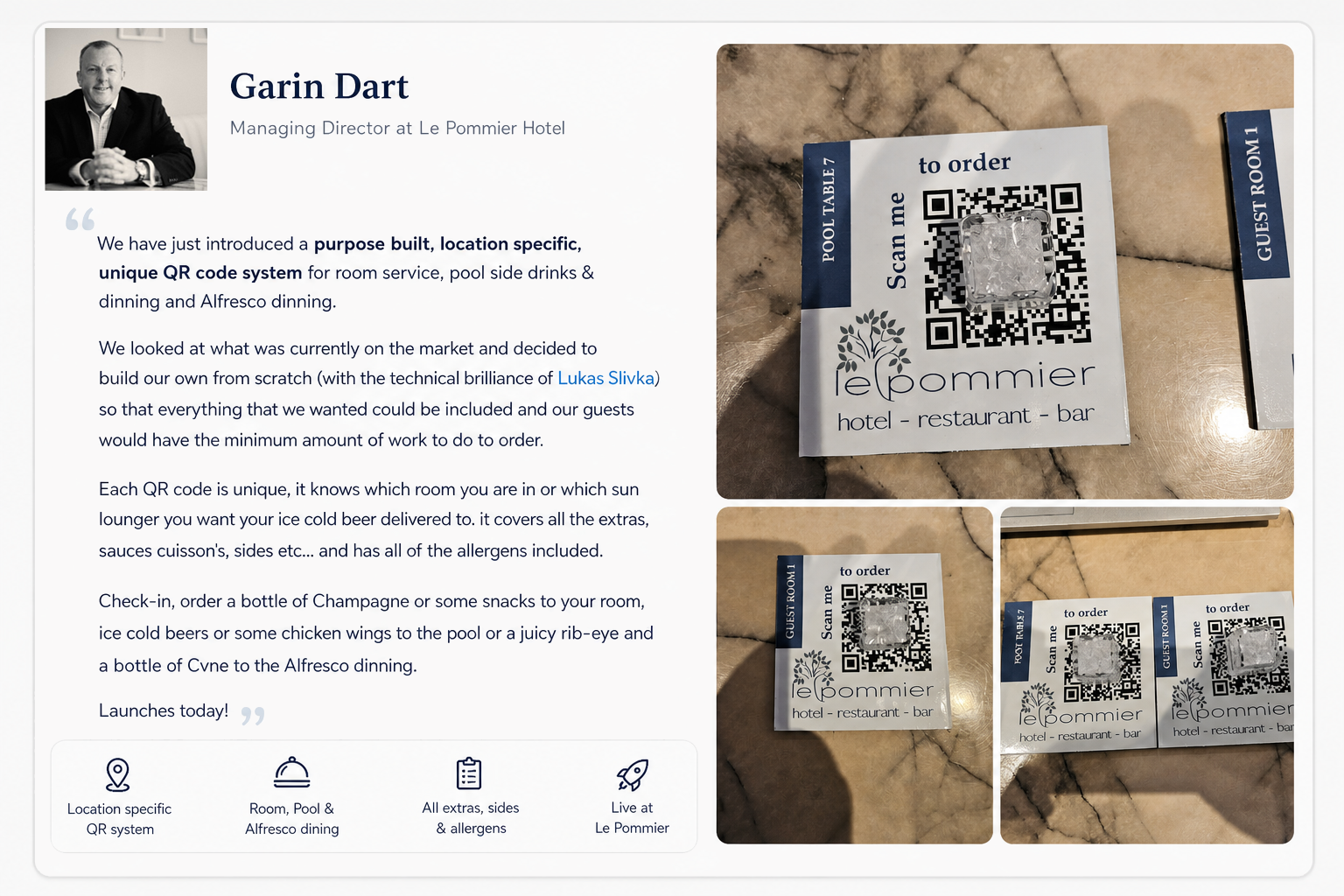
“We decided to build our own from scratch (with the technical brilliance of Lukas Slivka) so that everything that we wanted could be included and our guests would have the minimum amount of work to do to order.”
Garin Dart · Managing Director, Le Pommier HotelThe case study has moved well beyond the original QR pilot.
Since the first live launch, the product has been migrated into the QRelia SaaS architecture, expanded across guest, receiver, venue-admin and platform-admin workflows, connected to live subscription infrastructure, and extended into purpose-built LCD hardware. The May adoption numbers below remain an important early milestone; this is the current product context around them.
An early point where “working system” became visible guest adoption.
This historical snapshot is kept because it marks an important transition: guests were scanning, orders were arriving through the live system, and QRelia was producing meaningful operational volume under real service conditions. The platform has continued to evolve substantially since this milestone.
This milestone changed the meaning of the case study.
Earlier in the pilot, the case study had proved that QRelia could be designed, deployed and operated inside a real venue.
The 25–26 May numbers showed something stronger: guests were actually using it at meaningful scale during live service.
Reaching 38 completed orders on 26 May, after 17 completed orders on 25 May,
marked the point where the system moved from technical success into visible operational adoption — the difference between
“software installed” and “software becoming part of how the venue works”.
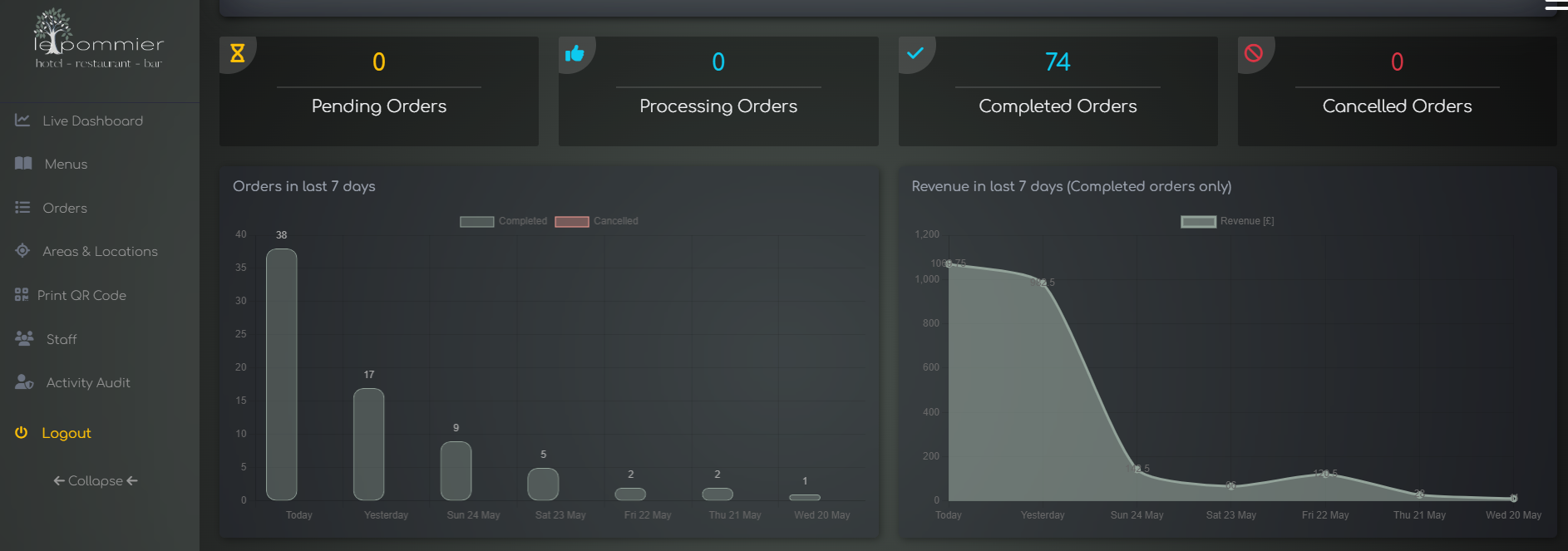
The milestone is not only the number. It is what the number represents: real guests, real orders, real staff workflow, and a system I designed end-to-end handling genuine hospitality demand.
Updated after the 25–26 May 2026 adoption spike at Le Pommier Hotel.The physical entry point into the system
Every interaction with the platform begins with a simple scan — but behind that scan sits a carefully structured entry into the correct operational context.
QR codes are not generic links. They are mapped to specific areas, locations and service flows within the venue, ensuring that each guest enters the system already aligned with their environment.
Designed QR Touchpoints
QR codes are placed across the venue in a way that feels natural rather than intrusive —
in rooms, on tables, and in poolside or outdoor areas.
Each design is tailored to fit the environment, maintaining a premium feel while clearly inviting interaction.
- Room-specific QR codes for direct room service ordering
- Table-based QR for dining areas
- Location-aware QR for poolside and outdoor service
Context-Aware Entry
When scanned, the QR does more than open a menu. It passes key parameters into the system —
such as location, area and tenant context — allowing the platform to understand exactly where the order is coming from.
This removes ambiguity for staff and ensures orders arrive structured and actionable from the very first interaction.
The QR code is not just a shortcut to a menu. It is the bridge between the physical venue and the digital system — connecting guests to service instantly while preserving the flow of real hospitality.
From one venue problem to a broader hospitality product
The initial requirement sounded simple: allow guests to order via QR code.
In practice, the real challenge was operational — ensuring orders are clear, correctly structured,
immediately visible to staff, and manageable under real service conditions.
Rather than building a surface-level solution, I designed a system where guest interaction feeds directly into
internal operations in real time. The result is not just ordering — it is a coordinated operational flow that reduces friction,
improves visibility, and creates a foundation that can scale beyond a single venue.
Designed for real hospitality environments, not a single use case
This system was not built for one static scenario. It was designed to operate across multiple service environments
within the venue, each with different expectations, pacing and operational constraints.
At Le Pommier, the platform supports:
Room Service
Guests can order directly from their rooms with full menu access, structured modifiers and clear delivery context, while staff receive clean, actionable orders without additional interpretation.
Poolside Ordering
A more dynamic environment where location awareness and speed matter. QR routing ensures orders are tied to the correct area, allowing staff to respond efficiently without confusion.
Al Fresco Dining
Outdoor dining introduces variability in service flow. The system maintains clarity across tables, modifiers and timing, while preserving a premium guest-facing experience.
Importantly, this system is not designed to replace human interaction — it enhances it.
By removing friction from ordering and reducing the need for guests to actively seek attention,
staff are able to focus on delivering the service itself rather than chasing requests.
The result is a shift from “in-your-face” service to hospitality on demand —
where the human touch arrives faster, more precisely, and at the moment it’s actually needed.
This is especially valuable in more private environments such as rooms, poolside areas or outdoor dining spaces.
The key idea is consistency: the same underlying system adapts to different environments without fragmenting the experience. This is where QRelia moves beyond “QR ordering” and becomes a unified operational layer across the venue.
What changed from before to after
The most important change was not that the venue gained a QR menu. It gained a clearer operating model: requests became structured, visibility improved, and the system started surfacing what was happening in real time instead of leaving staff to reconstruct it manually.
Before
Ordering and service coordination depended more heavily on manual handover, fragmented awareness, and staff needing to actively chase or interpret information under pressure.
After
Guest requests entered a structured real-time flow, staff could react from a clearer operational picture, and management had a stronger foundation for visibility, configuration, and future expansion.
Hospitality looks simple on the surface. It rarely is underneath.
Real hospitality operations contain edge cases everywhere: modifiers, timing, different menus by period, location-aware ordering, staff visibility, item availability, category ordering, wine-specific pricing rules, and the need to avoid adding more friction to already busy teams. Most generic QR systems flatten this complexity. I took the opposite route and built around it.
- Guests needed a smooth ordering flow that still respected real menu structure.
- Staff needed instant clarity, not another confusing dashboard.
- Management needed control over menus, areas, QR placement and operational changes.
- The product needed to be strong enough to become a reusable SaaS platform, not just a one-off build.
Build the venue solution like the first tenant of a larger product
Model the real workflow
I treated guest ordering, kitchen visibility and admin control as one continuous system rather than isolated pages.
Centralise logic in shared services
Core business logic, models, SignalR hub, EF Core access and tenant-aware services live in a shared library.
Design for scale from day one
Tenant propagation, grouped real-time broadcasting and modular apps created the base for the wider QRelia platform.
Push beyond software alone
The event architecture became QRelia Ambient: a working Raspberry Pi-based LCD device where live operational events drive both precise on-screen context and diffused addressable light.
What the platform actually does
This was not a brochure-site level build. It included meaningful operational logic, multiple applications, structured data flows, real-time communication and careful UX handling around menu complexity.
Guest Ordering Experience
Mobile-first customer journey with polished visuals, category-based menu browsing, basket creation, modifier selection, order confirmation and live order status updates.
Advanced Modifier Logic
Support for modifier groups, single or multi-select rules, min/max selections, color-coded options and clearer representation of order intent rather than raw item lists.
Wine-Specific Pricing Model
A dedicated inheritance-based model for wines supporting size-dependent pricing such as glass, 175ml, 250ml and bottle within the same broader menu architecture.
Kitchen / Receiver Interface
Separate receiver application for kitchen and staff devices, designed for clarity and supported by audio notification when new orders arrive.
Admin Control Layer
Manage locations, areas, menus, categories, items, modifier groups, staff accounts, QR generation, dashboard metrics and availability windows from a dedicated admin portal.
Course-Aware Service Flow
Orders can be organised around guest/course context, giving receiver staff clearer control over when service moves from pending into active preparation and delivery.
QR Print Studio
Single and batch QR generation, area-aware output, themed layouts and print/PDF tooling turn physical guest entry points into a managed part of the platform.
Analytics & Forecasting
Venue dashboards combine order KPIs, bestsellers, completion trends, kitchen reporting, weather context and forecasting so operational history becomes usable management information.
SaaS Onboarding & Subscriptions
Tenant onboarding, trial/subscription state, Stripe-backed commercial flows and platform administration support repeatable deployment rather than one-off installation.
Real-Time SignalR Workflow
New orders and order status changes propagate live across the platform, removing lag between guest action and staff awareness while also powering external connected devices.
QR Routing by Area & Location
QR codes direct guests into the correct context, passing through ordering parameters so the platform knows where the order originated.
Multi-Tenant Foundation
Tenant-aware middleware, grouped broadcasts and data isolation mean the same product architecture can serve multiple venues under the QRelia platform.
QRelia Ambient Hardware
The event stream now drives a dedicated 3.5-inch LCD device with state-aware UI, Wi-Fi/cloud status and diffused addressable LED animations — bridging digital workflow and physical space with working hardware rather than a future concept.
A modular system built for delivery now and scale later
QRelia now operates as a connected application suite around a shared domain, tenant model and real-time event spine. That structure supports fast venue iteration while keeping customer, receiver, administration, onboarding and platform concerns separated and reusable.
Why this mattered
Hospitality software can become messy very quickly when features are added in reaction to operations. I deliberately centralised the domain and service logic so each application stays focused on its role while the rules remain consistent across the whole platform.
- Shared domain logic reduces drift between customer, admin and receiver apps.
- SignalR hub becomes the operational spine of the system.
- Tenant-aware grouping keeps the SaaS path viable.
- External device listeners are already real: QRelia Ambient consumes the same live event stream without changing the core workflow model.
Solving for real use, not just visual polish
Good hospitality UX is not just about making things look elegant. It is about reducing decision friction for guests and operational friction for staff at the same time. That shaped many implementation decisions, from how modifiers are presented to how menu categories are ordered and how order states appear live.
- Premium UI language with gradients, blur, spacing and visual hierarchy.
- Ordering flow designed around clarity, not feature dumping.
- Improved representation of complex item configurations.
- Admin controls focused on actual day-to-day venue needs.
- Platform-level UX now spans customer themes, social/booking actions, QR controls and richer service-state feedback.
Real-time isn’t a gimmick here. It changes the workflow.
When a guest places an order, the system doesn’t simply save it and hope someone notices. It triggers a real-time chain across the venue. Receiver devices update, staff get immediate awareness, statuses can flow back to the guest journey, and the same event stream can also drive connected ambient hardware.
- New order broadcasts reduce manual checking.
- Status updates help keep the guest informed.
- Operational signals can be consumed by multiple interfaces at once.
- This same pattern becomes a major differentiator for QRelia as a platform.
Ambient operational computing is no longer a direction. I built it.
The original event-driven architecture made a physical service interface possible. The latest QRelia Ambient build turns that idea into a finished working object: a Raspberry Pi-based 3.5-inch LCD device, purpose-built status interface, guided Wi-Fi setup, cloud connectivity and a diffused addressable LED signal driven by QRelia service states.
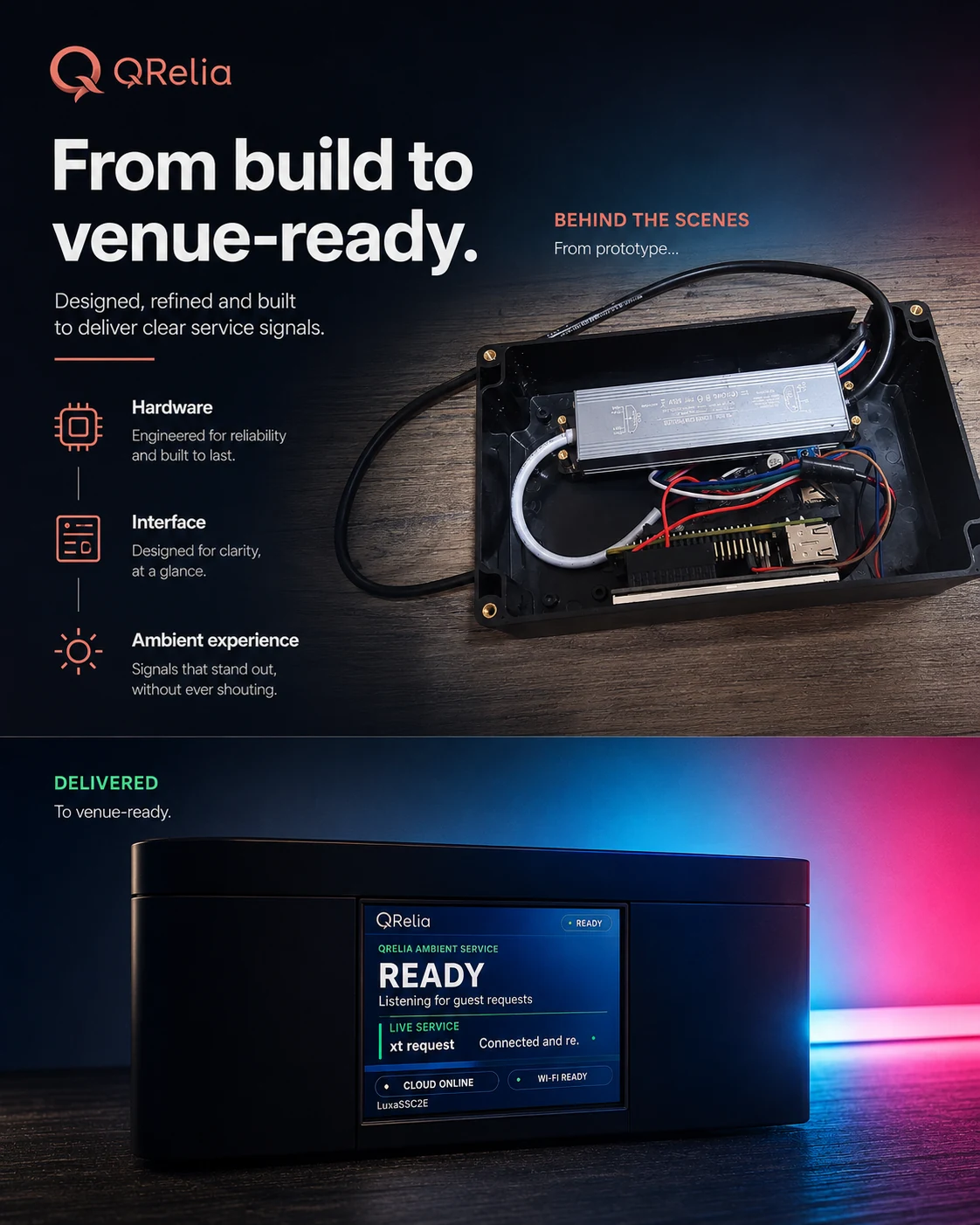
Glanceable operational context
The screen shows service state, order context, connectivity and local device information instead of relying on a generic indicator light.
Diffused ambient signalling
State-specific addressable animations make new orders, attention states, ready status and connection conditions visible across the room.
Self-contained venue setup
The device supports guided Wi-Fi provisioning, pairing, cloud reconnection and recovery logic so setup is part of the product rather than a bench-only process.
Same real-time spine
SignalR events that update QRelia software can drive the device too, keeping the physical environment synchronized with staff workflow.
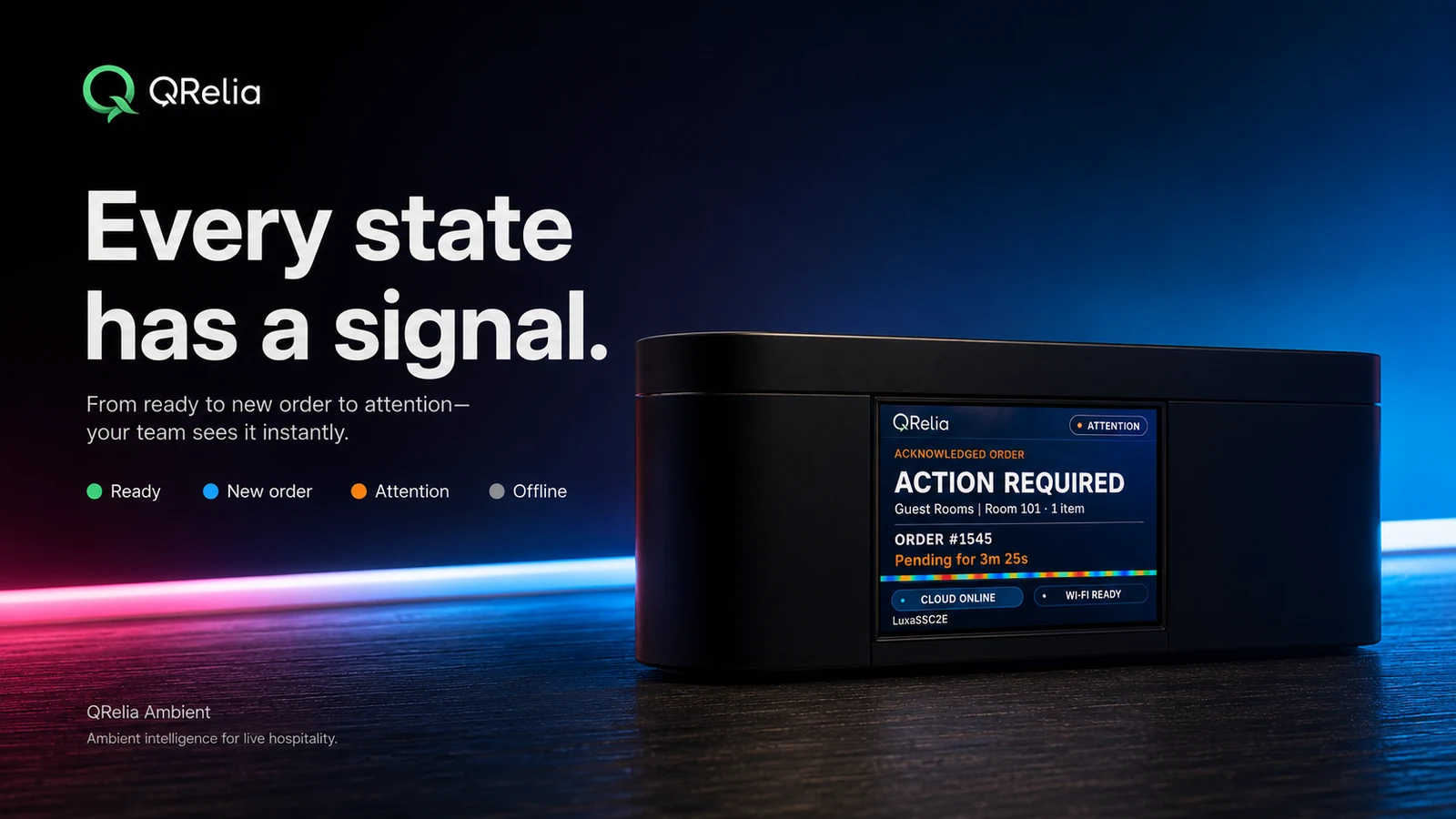
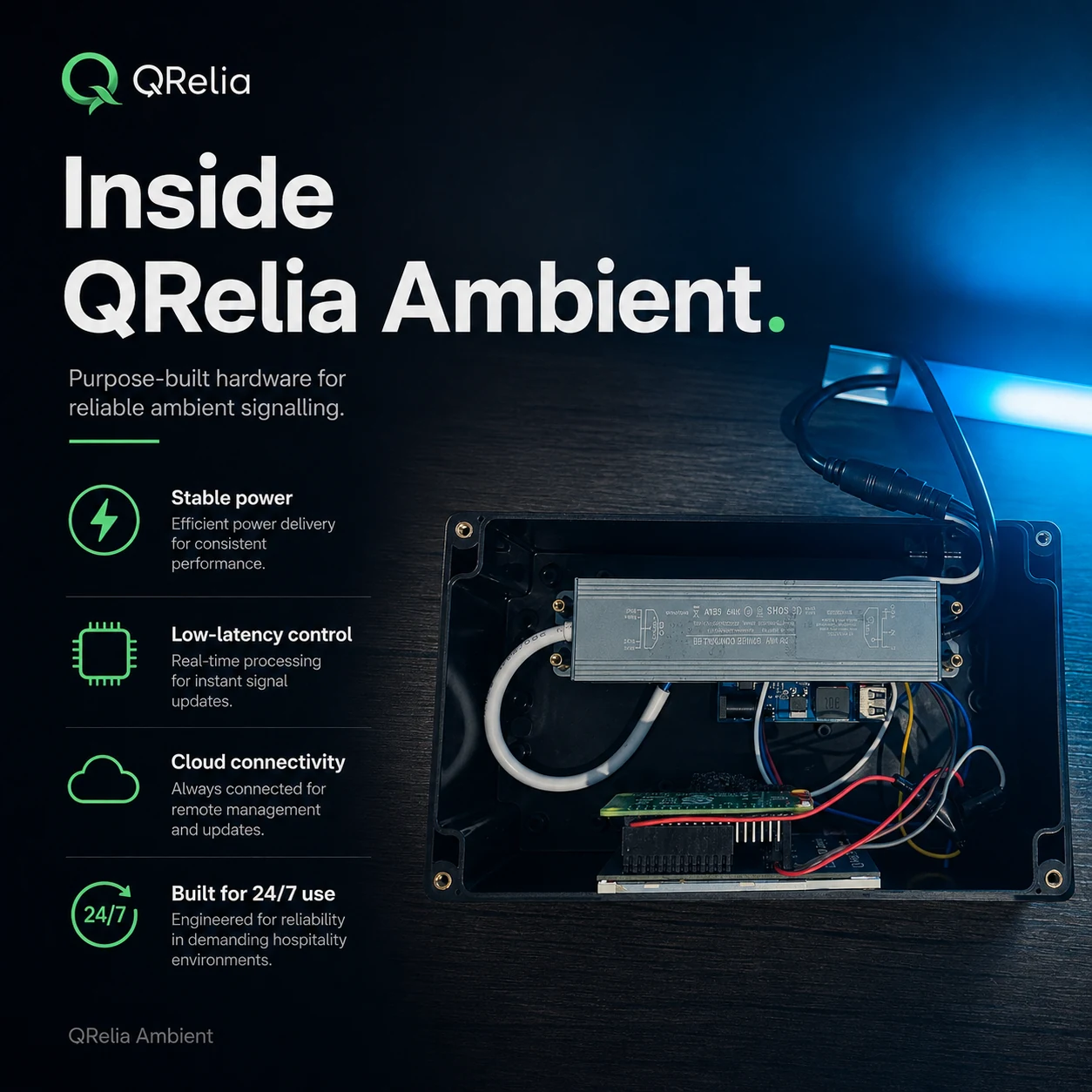
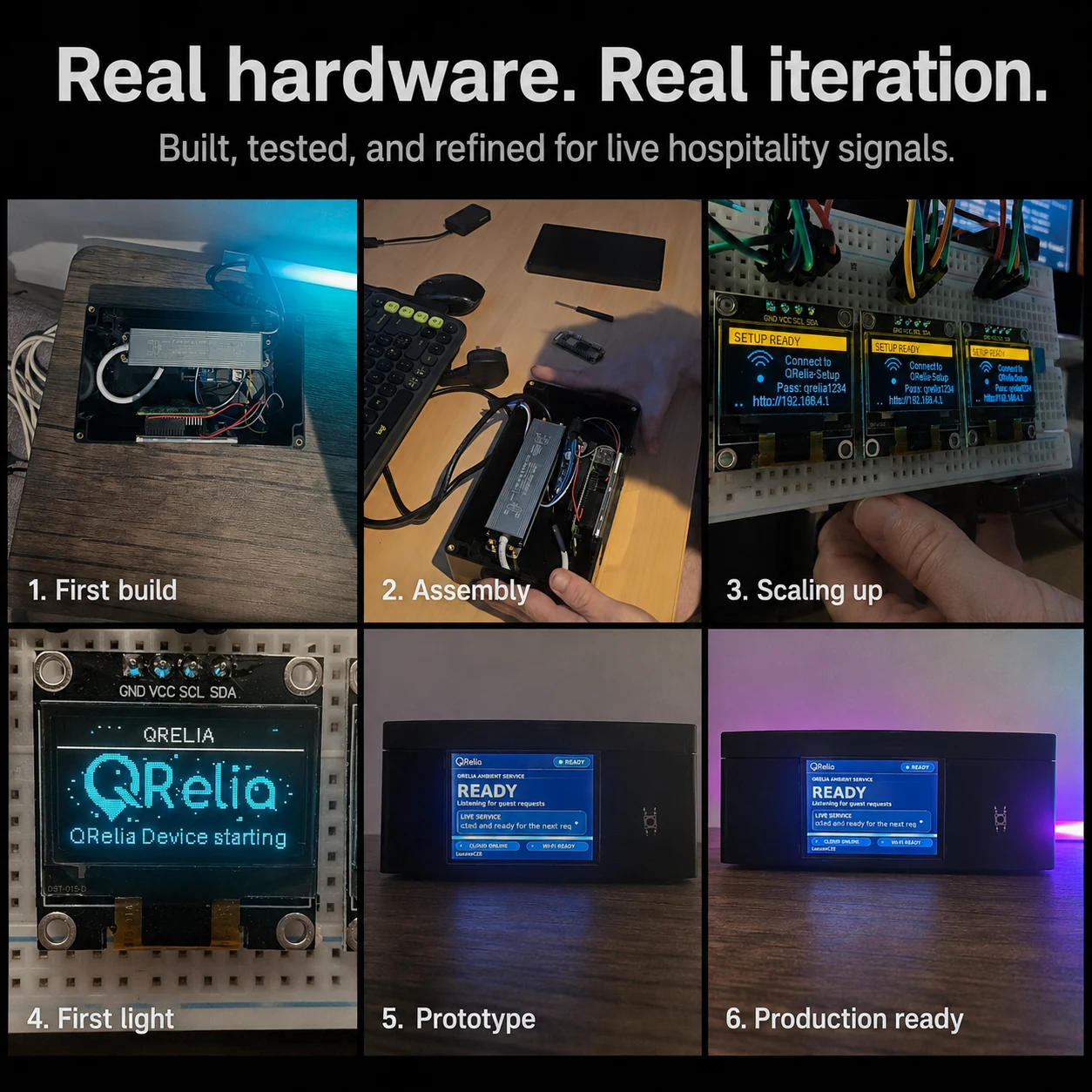
The differentiator is not “an LED strip”. It is the end-to-end loop: a guest action becomes a server event, a staff workflow update, a management data point and a physical signal in the room — all representing the same operational state.
QRelia Ambient extends the platform into the physical hospitality environment.What this case study proves
This project reflects how I work at my best: I do not just implement pages or features in isolation. I connect product thinking, technical architecture, operational understanding, interface quality, and commercial direction into one system.
I build full systems, not fragments
From guest flow to admin tooling to receiver interface to live event architecture, the whole delivery is connected.
I can turn a venue problem into product infrastructure
The Le Pommier delivery was not trapped as a one-off. It became the foundation for QRelia.
I think beyond obvious software boundaries
The IoT direction emerged naturally because the system was built around real-time operational events rather than isolated screens.
I care about UX and operational reliability equally
Premium visuals matter, but only when they sit on top of solid workflow, real clarity, and durable implementation.
I work well with real-world operational detail
Hospitality brings edge cases, exceptions, and timing constraints. I am comfortable building inside that reality instead of simplifying it away.
I design with scale in mind
Tenant-aware architecture, modular apps, and shared business logic gave this project a future beyond one venue.
QRelia started as a venue solution. It is now a multi-tenant hospitality platform.
The Le Pommier case study captures a transition point in my work: from delivering bespoke software to shaping a product with broader strategic potential. It shows how a real client engagement became the proving ground for a branded SaaS platform with live onboarding and subscription infrastructure, richer operational tooling, scalable architecture, and a dedicated LCD hardware layer that carries digital state into physical space.